Showing posts with label SIHH 2012. Show all posts

Thursday, May 24, 2012

The IWC Mark XVII - Redesigning a classic

How do you redesign a classic? Very carefully.  

The new IWC Mark XVII. Photo is from the Ace Jewelers
and is used with their permission. All rights to the use of this picture is
 reserved by Ace Jewelers and no republication of the same should be made
 without permission from Ace Jewelers. Ace Jewelers is a family run company with three stores located in the City of Amsterdam, The Netherlands.

The IWC Mark XVII announced in January 2012 can trace it heritage back for almost 70 years beginning with the IWC Mark X.

IWC Mark X. The first IWC Mark watch, the Mark X, was based on order from the British military. In the early 1940's the British Ministry of Defense put out a specification set for rugged military watches to supply its troops. Several manufacturers including Longines, Jaeger LeCoultre (JLC), Omega, Lemania, Eterna and the International Watch Company (IWC) supplied Mark X watches starting in 1944.

IWC Mark X
The appearance of the IWC Mark X was similar to the Mark X watches of other manufacturers, with the main differences being the shape of the hands and case. The elements of the dial were nearly identical across the different Mark X watches. The dial featured Arabic numerals, running seconds were displayed in a sub-dial and the watch had "train tracks" around the sub-seconds chapter. Even the IWC manufactured Mark X's came with four different configurations which varied a little, in the design of the hands and dial.

IWC Mark XI. The Mark X was used as a basis for another watch designed for the British Military. The Mark XI was built based on specifications for the British Royal Air Force in 1949. The Mark XI also marked the transition of the watch from a durable watch to a dedicated pilot's watch. Inside, an inner soft iron cage was added which shielded the movement against magnetic interference. The crystal was redesigned, with a screwed ring to prevent it from detaching from the case during sudden depressurization. The contract for the manufacture of the Mark XI watches was awarded to IWC and JLC.  

Mark XI watches were also purchased by the Royal Australian Air Force, Royal New Zealand Air Force, South African Air Force and the British Overseas Airways Corporation (now British Airways).

IWC Mark XI

The most apparent changes in the design are the center mounted seconds hand and emphasis on illumination at the 3, 6, 9 and 12 o'clock positions.

The Mark XI would continue to be used by the Royal Air Force for 32 years, until they were decommissioned in 1981, with the Royal Air Force moving on to quartz watches. IWC stopped producing the Mark XI in 1984.

IWC Mark XII, XV and XVI. The IWC Mark XII was the first commercial variant of the watch, IWC having relaunched the design and Mark name in 1993. The Mark XII added a date display to the watch at the 3 o'clock position which replaced the 3 numeral, but the design retained the elements of the Mark XI dial. 

In 1999, the Mark XV was replaced the Mark XII in IWC's line-up. The major difference between the design of the Mark VII and Mark XV being an increase of the case diameter from 36.5 mm to 38 mm. 

In 2006, the IWC Mark XVI was announced, replacing the Mark XV. The 6 and 9 numeral were dropped from the dial and the watch moved to a new larger 39 mm case.

IWC Mark XVI       
  
IWC Mark XVII. The IWC Mark XVII represents the first major redesign of IWC Mark watch in almost two decades. 

IWC Mark XVII

The diameter of the Mark XVII case now stands at 41 mm, which would be in keeping with contemporary standards of how big a gentleman's watch should be. The only substantial change in the design of the dial is the date display.

Instead of the stark unadorned aperture located at the three o'clock, you now have a window displaying three dates. The current date is located in the middle and is indicated by a small red triangle. The design of the date window is nothing new. We have seen IWC use a window displaying three figures in watches like the IWC UTC watches, although in that implementation the window displays the second time zone. 

These simple changes do make substantial differences in the look of the dial of the watch. It highlights the date display in a subtle manner, instead of other options like encasing the aperture in a white gold or silver colored frame. The small red triangle, adding a dash of red to what has traditionally been a bi-color, and stark, black and white design. Overall IWC's new Mark watch, has ayounger, fresher and more contemporary look to it, without detracting from the professional no-nonsense look of the design. 

About IWC. IWC or the the "International Watch Co. Schaffhausen" was founded by an American engineer from Boston, Florentine Ariosto Jones, in Schaffhausen, Switzerland in the year 1868. IWC Schaffhausen is notable for being the only major Swiss watch factory located in eastern Switzerland, as the majority of the well-known Swiss watch manufacturers are located in western Switzerland.

Thursday, February 16, 2012

SIHH 2012: Officine Panerai Radiomir S.L.C. 3 Days PAM00424

Siluro a Lento Corsa. Siluro a Lento Corsa or S.L.C. was a slow-speed torpedo used by Royal Italian Navy rode during world war two. It was crewed by two navy commando divers.

Image from Wikipedia

In commemoration of the S.L.C. and the brave mean that crewed them, Officine Panerai has released the Radiomir S.L.C. 3 Days PAM00425. 

Officine Panerai Radiomir S.L.C. 3 Days PAM00424. The PAM 425 is 47 mm watch built on a Radiomir, with a clean dial that only shows hours and minutes.  The dial has dots and bar hour markets with a slow-speed torpedo etched on the dial.


The dot and stick markers are supposedly the design used for the first pancake in the 1930's The pancake dial is a three layer design where the luminescent material is place in between two dials rather than being painted on a dial. 

 The 47 mm case is made from stainless steel. A sapphire crystal glass protects the dial. Inside is a Officine Panerai's P.3000 calibre. This is an in-house movement entirely designed by Officine Panerai and manufactured in Neuchâtel facility. The P.3000 calibre has a three day power reserve and produces 21,600 vibrations per hour. It is visible through a sapphire crystal case back.


About Panerai. Officine Panerai was founded in 1860 in Florence, Italy by Giovani Panerai. Panerai was acquired over by Swiss watchmaker Richemont S. A. in 1997.

Tuesday, February 14, 2012

SIHH 2012: IWC Big Pilot's Watch Perpetual Calendar Top Gun

Haute Horlogerie. We have one more IWC watch, released at SIHH 2012, to cover, and it may be the most impressive of the new offerings, the IWC Big Pilot's Watch Perpetual Calendar Top Gun. This watch combines the seven day power reserve found in IWC's Big Pilots watches, with what we think is the grandest of all complications, the Perpetual Calendar.

The typical watch has enough reserve power to run 2 to 3 days without needing to be recharged by winding or the natural movement of the arm which winds automatic watches. IWC's 7-day power reserve is more than a cut above the standard. In addition, it actually has a 8.5 day power reserve, but the watch only runs for 7 days, as when the the watch reaches the end of its power band accuracy suffers. 

The perpetual calendar function removes the need to be adjust every other month to take into account that some months have 28 days and 30 days rather than 31 days, and to account for leap years. A perpetual calendar is a mechanism that automatically takes into account the varying number of days in each month as well as leap years so that the watch displays the correct date each month without the need of adjustment. The movement in the IWC Big Pilot's Watch Perpetual Calendar Top Gun will not require intervention until the year 2100, a year that breaks with the conventional four-year cycle and will not be a leap year. 

Bring together these two features, makes for one impressive watch.


IWC Big Pilot's Watch Perpetual Calendar Top Gun. The IWC Big Pilot's Watch Perpetual Calendar Top Gun is a imposing watch with a 48 mm case diameter. It makes full use of its large dial. 

Starting at the 12 o'clock position you have a perpetual moonphase display, displaying the phases of the moon in both the Northern and Southern hemispheres.


Moving on to the 3 o'clock position you have a sub-dial with two hands, one of which displays the power reserve and the other the date. At the 6 o'clock position, the watch displays the month. The year is displayed by a Windows between the 7 o'clock and 8 o'clock positions. 

At the 9 o'clock position you have a sub-dial with two hands, one displaying the day, and the other continuous seconds.

The case is made out of a combination of ceramic and titanium with a strap made of a soft synthetic material. Part of me feels the modern look does not necessarily fit a perpetual calendar. I hope in the future we see a "classic" version of this watch on a stainless steel or white gold case with a leather strap.


About IWC. IWC or the the "International Watch Co. Schaffhausen" was founded by an American engineer from Boston, Florentine Ariosto Jones, in Schaffhausen, Switzerland in the year 1868. IWC Schaffhausen is notable for being the only major Swiss watch factory located in eastern Switzerland, as the majority of the well-known Swiss watch manufacturers are located in western Switzerland.


Monday, February 13, 2012

Officine Panerai Luminor 1950 3 Days Power Reserve 47 mm

The other 47 mm 1950 at SIHH 2012. We are about to finish with a look at the new Officine Panerai watches released released at SIHH 2012. There are three more Panerai watches for us to cover. The next one, is not our favorite new Panerai release: The Officine Panerai Luminor 1950 3 Days Power Reserve 47 mm or PAM00423.


Officine Panerai Luminor 1950 3 Days Power Reserve 47 mm. The PAM 423 as indicated by its name is built around a 47 mm diameter 1950 design Luminor case. The 1950 case, with the domed crystal, looks really nice in the size. Inside the watch is a built by Panerai P.3002 movement which produces 21,600 vibration per hour and has a long than average three day power reserve. A nicely designed watch, with an in-house movement. What is not to like?
The distinguishing feature of this watch, as against other Panerai 1950 Luminor designs is the power reserve indicator found at the 4-o'clock. This feature is what will compel a buyer to buy this watch or pass it on. Personally, I would go with the cleaner dial of the 47 mm Luminor 1950 PAM 422, but choices are always a good thing.

About Panerai. Officine Panerai was founded in 1860 in Florence, Italy by Giovani Panerai. Panerai was acquired over by Swiss watchmaker Richemont S. A. in 1997.

Saturday, February 11, 2012

SIHH: The new IWC Big Pilots Watch Family

The true star of IWC's line-up in 2012 has to be the IWC Big Pilot's Watch. This watch, which took its inspiration from watches designed for the German Air Force (Luftwaffe) in World War II, has emerged from the re-design of the IWC's Pilots Watch family unchanged. Nothing highlights success as well as that.

The Big Pilots watch has a large 46 mm case which made it current given the trend to favor large watches. It's self winding movement with a 7 day power reserve made it interesting enough for aficionados.   

The original...
Instead of being redesign, the Big Pilot inspired two new designs. 

... the contemporary Air Force inspired edition...

IWC Big Pilot's Watch TOP GUN Ref. 5019. The IWC Big Pilot's Watch TOP GUN is a modern re-interpretation of the Big Pilot's Watch. Instead of stainless steel and leather, you have a black zirconium oxide and strap made of synthetic soft material. The case is an even larger 48 mm than the 46 mm IWC Big Pilot's Watch.

... and one for the Marine Aviators.

IWC Big Pilot's Watch TOP GUN Miramar Ref. 5019. If the stark black of the IWC Big Pilot's Watch TOP GUN is the contemporary air force inspired version of the Big Pilot's Watch, the IWC Big Pilot's Watch TOP GUN Miramar is the Marine Aviators variant with its green textile strap and grey ceramic and titanium case. This watch also is 48 mm in diameter.  

More than skin deep. The appeal of these watches extends beyond the massive case and beautiful design. The IWC Big Pilots watch belongs to IWC's 50000 series, being powered by built-by-IWC Calibre 51111 movement. This self-winding movement produces 21,600 vibrations per hour and has an 8.5 day power reserve, however the watch will only run for 7 days when fully wound. A mechanism stops the watch when it only has 1.5 days power left. This is because, according to IWC "the torque that drives the movement decreases as the mainspring winds down, leading to a loss of amplitude in the balance and the unacceptable possibility of inaccuracy." I don't think it will matter much if you wear it frequently. A long power reserve is not usually a feature in automatic watches. IWC does have a tendency of doing things a bit differently from everybody else.


The Calibre 51111 movement also features the Pellaton Winding System, which was created by than IWC Technical Director, Albert Pellaton in the 1940's. Unlike the design of other watches, the movement of the rotor is not transmitted to a wheel train via a gear system but through a cam. This supposedly makes the rotor wheel more durable.

About IWC. IWC or the the "International Watch Co. Schaffhausen" was founded by an American engineer from Boston, Florentine Ariosto Jones, in Schaffhausen, Switzerland in the year 1868. IWC Schaffhausen is notable for being the only major Swiss watch factory located in eastern Switzerland, as the majority of the well-known Swiss watch manufacturers are located in western Switzerland.

Wednesday, February 8, 2012

SIHH 2012: Officine Panerai Luminor 1950 Tourbillon GMT Ceramica PAM 00396.


Officine Panerai Luminor 1950 Tourbillon GMT Ceramica PAM 00396. If you are looking for the flagship Panerai released at SIHH 2012, it has to be Luminor 1950 Tourbillon GMT Ceramica PAM00396. This watch combines the dual time with the Tourbillon complication. Dual time is displayed in the usual Panera way. A second hour hand that rotates once every twelve hours is used, instead of the more common 24-hour hand. In order to determine whether it is day or night in the second time zone, a small dial at 3 oclock has a am/pm indicator.  

The watch does not have an open dial which shows the Tourbillion movement on its face. Insteas a small seconds dial, at 9 oclock, ontains an a series of dot markers, which is connected to the tourbillon and moves at twice the speed of the seconds hand, completing one revolution in 30 seconds.


What is a tourbillon? The tourbillon was invented in 1795 by Abraham-Louis Breguet. Mechanical timepieces are affected by gravity. In order to counter the effects of gravity, Abraham-Louis Breguet built a watch that counteracted gravity by rotating the balance wheel of a watch or clock through 360 degrees. This is called a tourbillon.

This is accomplished by mounting the escapement in a rotating frame, called a "carriage" which turns at regular intervals, usually once a minute. This rotation reduces the positional errors of the movement.

At that time almost Abraham-Louis Breguet invented the tourbillon almost all watches were pocket watches which stayed in one position most of the time. The only time a pocket watch changes position is when it's taken out by the owner to check the time.

The effect of gravity on a watch or clock kept in one position all the time, like a pocket watch, is particularly noticeable on the escapement, especially the balance which rocks back and forth. This can lead to inaccuracies. Breuget's solution was the tourbillon.


Today, most tourbillons are found in wristwatches. People tend to move their arm as they go about their day, which provides the changes in position required to offset the effects of gravity on the watch movement. This negates the need for one a tourbillon. Today tourbillon watches are valued as a display of watchmaking prowess, in the same way complication watches are desirable.

Ceramica. The PAM 396 has a 48 mm diameter Luminor 1950 case with a synthetic ceramic based on zirconium powder which coating. This process creates a uniform and even matt black appearance, as well as ensuring excellent performance in terms of hardness, resistance to scratches, corrosive agents and high temperatures. The case is made from stainless steel and titanium.


Movement. Inside, is the built by Panerai P.2005 which produced 28,800 vibrations per hour and has a long 6-day power reserve. The movement has a sapphire crystal on the caseback allowing you to view the movement and power reserve indicator.

About Panerai. Officine Panerai was founded in 1860 in Florence, Italy by Giovani Panerai. Panerai was acquired over by Swiss watchmaker Richemont S. A. in 1997.

Monday, February 6, 2012

Which is your favorite new IWC chronograph pilots watch?

Year of the Pilot's Chronographs. At SIHH 2012, IWC announced six new chronograph watches:


There is pretty much something for everybody, as they not only vary in styles but also in terms of movements. The Pilots Watch Chronograph uses a basic chronograph movement. The new Spitfire, Spitfire Perpetual Calendar, Top Gun, and Top Gun Miramar chronographs feature flyback movements. You also have a double chronograph option available.


My favorite is the the new Spitfire Chronograph Ref. 3878. I love the new cleaner dial with only two sub-dials. The flyback function makes it special enough, being a cut above the typical chronograph.
 
Which is yours?
 

SIHH 2012: IWC Spitfire Perpetual Calendar Digital Date-Month Ref. 3791

Flagship Pilots Watch. While IWC has offered a who gaggle of new Pilot's chronograph watches at SIHH: 2012, the flagship model for the year has to be the Spitfire Perpetual Calendar Digital Date-Month (Ref. 3791). This watch combines a stopwatch function with a perpertual calendar complication.


IWC Spitfire Perpetual Calendar Digital Date-Month Ref. 3791. The Spitfire Perpetual Calendar Digital Date-Month most interesting feature is the perpetual calendar. The date display on the typical watch has to be adjusted every other month to take into account that some months have 28 day, 30 days and 31 days, and to account for leap years. The perpetual calendar has a intricate movement that does that adjusting for you. A perpetual calendar is a mechanism that automatically takes into account the varying number of days in each month as well as leap years so that the watch displays the correct date each month without the need of adjustment. The movement in the Spitfire Perpetual Calendar Digital Date-Month will not require intervention until the year 2100, a year that breaks with the conventional four-year cycle and will not be a leap year. 

In addition, the watch also has a chronograph function, with hours and minutes of elapsed time being displayed in a sub-dial at the 12 o'clock. This totalizer is also special in the sense that it combines readings that are usually in two separate subdials, one for minutes and the other for hours. In the Spitfire Perpetual Calendar Digital Date-Month, two hands are used in one sub-dial. The chronograph movement features the flyback function which allows you to restart the count with a single button.

Despite the highly complex movement, this still has a excellent 68 hour power reserve.

Big Windows. The Spitfire Perpetual Calendar Digital Date-Month is the first IWC Pilot’s Watch to feature a digital display showing the date and month in large numerals. The large date and month windows was inspired by cockpit instrumentation that shows vital data, such as altitude, in figures. The four-year leap year cycle is also displayed digitally by a windows in the sub-dial at the 6 o'clock which display continuous seconds.  

Case. Befitting its stature as a exclusive piece, it comes in a case made of 18 carat red gold. The case is an imposing 46 mm in diameter. What this watch lacks is the soft iron inner ring for protection against magnetic interference which are found in IWC's other pilots watches. Presumably, this was removed to make room for the rather complicated movement inside.
The hours and minutes recorded by the stopwatch can be read off on the totalizer at “12 o’clock” as easily as reading the time, while the central chronograph hand shows the elapsed seconds. Thanks to the integrated flyback function, the stopwatch hand can be returned to zero and immediately starts recording another period of time. The watch owes its premium-quality look to the vibrant interchange of polished and satin-finished surfaces on the 18-carat red gold case. The shimmering, slate-coloured, metallic dial has a sun-pattern finish that creates a captivating contrast with the warm gold tone and the brown of the alligator leather strap.

About IWC. IWC or the the "International Watch Co. Schaffhausen" was founded by an American engineer from Boston, Florentine Ariosto Jones, in Schaffhausen, Switzerland in the year 1868. IWC Schaffhausen is notable for being the only major Swiss watch factory located in eastern Switzerland, as the majority of the well-known Swiss watch manufacturers are located in western Switzerland.

Sunday, February 5, 2012

SIHH 2012: IWC Pilot's Watch Double Chronograph Ref. 3778

Chronographs. I do not think there has been a year when IWC has released so many chronographs. At SIHH 2012, IWC announced six new chronograph watches:


This is probably the largest number of chronographs IWC has launched in a single show. Aside from the number, the movements used are also very impressive. Only the Pilots Watch Chronograph uses a basic chronograph movement. The new Spitfire, Spitfire Perpetual Calendar, Top Gun, and Top Gun Miramar chronographs feature flyback movements.

The most complex chronograph announced by IWC at SIHH 2012 is found in the Pilot's Watch Double Chronograph which features a splits second chronograph.


Split second chronograph. The basic chronograph allows the measurement of a single event. A flyback allows for a quick restart. The split seconds chronograph is what is more commonly referred to today as a lap timer.

This was done by having two chronograph seconds hands. When started the two hands move as one. One hand can be stopped while allowing the second one to continue moving. This is useful in measuring lap times. One hand can be stopped so the lap time can be accurately recorded, and after that stopped hand will catch up with the moving hand an continue to measure the total elapsed time.

A split-seconds chronograph features a clutch system with clamps that connect and disconnect the split-seconds hand and the main chronograph hand. A third button is added to the chronograph to activate the stopping of the split-seconds hand. Pressing this third button again allows the split-seconds hand hand to catch up with the chronograph hand, and the two hands, superimposed, continue together.


IWC Pilot's Watch Double Chronograph.The IWC Pilot's Watch Double Chronograph is a large watch, with a 46 mm diameter stainless steel case. Two sub-dials at the 12 o'clock and 6 o'clock position are used in conjunction with the stopwatch to measure period of time of up to 12 hours. A sub-dial at the 9 o'clock is used to display continous seconds.

The date display is the three date windows which is a trademark of the IWC 2012 pilot's watches. The IWC Pilot's Watch Double Chronograph also displays the day. The movement used as a 44 hour power reserve. 

Like all the IWC pilot's watches it features the soft iron case to resist magnetism and a sapphire crystal glass secured against displacement by drop in air pressure.

About IWC. IWC or the the "International Watch Co. Schaffhausen" was founded by an American engineer from Boston, Florentine Ariosto Jones, in Schaffhausen, Switzerland in the year 1868. IWC Schaffhausen is notable for being the only major Swiss watch factory located in eastern Switzerland, as the majority of the well-known Swiss watch manufacturers are located in western Switzerland.


Saturday, February 4, 2012

SIHH 2012: Officine Panerai Radiomir GMT - 8 Days Oso Rosso - 45 MM PAM00395

Special Editions. At SIHH 2012, Officine Panerai announced five Special Edition watches. All Panerai watches are manufactured in limited quantities, the Special Editions are manufactured in even more limited numbers, usually in the hundreds, and are manufactured only for a single year. In previous articles we already took a look at four of the 2012 Special Editions, the PAM 398, 399, 448 and 449.  The fifth Special Edition watch from Panerai for 2012 is the Radiomir GMT - 8 Days Oso Rosso - 45 MM PAM00395. Only 500 pieces of this watch are being produced.


Officine Panerai Radiomir GMT - 8 Days Oso Rosso - 45 MM PAM00395. The Panerai Radiomir GMT - 8 Days Oso Rosso is a dual time watch, but I suspect buyers would be more interested in the long eight day power reserve of the Panerai 2002/10 calibre movement, which is a more exclusive feature. A power reserve indicator is visible on the dial of the watch.

The second time zone is displayed in the now the manner that is now a trademark of most Panerai dual time watches, via a smaller second hour which rotates once every 12-hours, rather than the 24-hour hand found in most dual time watches. A day/night indicator located at the 9-o'clock position is used to tell you whether it is a.m. or p.m., in the second time zone.  The day/night indicator shares the same sub-dial as the running seconds. The final feature on the dial is a date display at the 3 o'clock.


As its name indicates, the watches 45 mm diameter case is made from Red Gold. The back of the case has a sapphire crystal case back which allows you to view the movement.

About Panerai. Officine Panerai was founded in 1860 in Florence, Italy by Giovani Panerai. Panerai was acquired over by Swiss watchmaker Richemont S. A. in 1997.


Friday, February 3, 2012

SIHH 2012: IWC Pilot's Watch Chronograph Top Gun Ref. 3880

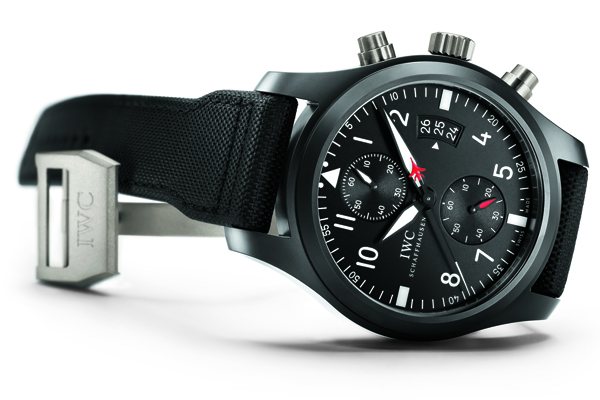
Top Gun Chronograph. We already took a look at the new IWC Pilot's Watch Chronograph and the IWC Spitfire Chronograph, both of which take their design cues from classic World War II styles. IWC's more contemporary Pilot's watches made by IWC for part of the Top Gun Series. "Top Gun" is a reference to the United States Navy Fighter Weapons School. A new model announced at SIHH 2012 is the IWC Pilot's Watch Chronograph Top Gun Ref. 3880.


IWC Pilot's Watch Chronograph Top Gun Ref. 3880. In keeping with the more contemporary design the case of the IWC Pilot's Watch Chronograph Top Gun is made of lightweight titanium coated with a ceramic finish to prevent scratches and with a black soft strap.
The watch has a large 46 mm diameter case, which in keeping with its Pilot's Watch heritage house a soft iron inner ring to protect the movement against magnetic fields. Inside is a built by IWC calibre-89365 chronograph movement. This is the same movement used in the new IWC Spitfire Chronograph.

This movement beats a 28,800 vibration per hour and has 8-hour power reserve. The dial is designed to resemble an resembles an altimeter with a silhouette of a jet adorning the main second hand. Luminescent white hands and markets provide for outstanding legibility.

The main second hand is use in conjunction with the chronograph functions, shows recorded times in seconds, while the small white hand in the subdial at 12 o’clock displays the number of elapsed minutes. Continuous seconds are displayed at the subdial at the 6 o'clock. The date is displayed in a window displaying three separate dates, with the current date in the middle.  

The movement has  a flyback function. Depressing the reset button returns the running stopwatch hand to zero and immediately starts recording another period of time.  


The caseback of the watch has the logo of the United States Navy Fighter Weapons School.

About IWC. IWC or the the "International Watch Co. Schaffhausen" was founded by an American engineer from Boston, Florentine Ariosto Jones, in Schaffhausen, Switzerland in the year 1868. IWC Schaffhausen is notable for being the only major Swiss watch factory located in eastern Switzerland, as the majority of the well-known Swiss watch manufacturers are located in western Switzerland.

Monday, January 30, 2012

SIHH 2012: Officine Panerai Special Edition Radiomir California 3 Days (PAM00448) and Radiomir S.L.C. 3 days (PAM00449)


"Vintage". In keeping with Officine Panerai's recent trend of manufacturing historic watches with more historically accurate materials Panerai announced at SIHH 2012 two exclusive Special Editions Radiomir watches, the California 3 Days (PAM00448) and the Radiomir S.L.C. 3 Days (PAM00449). Each watch will be produced in a limited quantity of only 500 units each.

The main feature of the two Special Editions dial protected by a Plexiglas crystal instead of a sapphire crystal one used in most watches today one. To highlight the emphasis on the historical nature of this watch Panerai engraved the the word "VINTAGE" between the strap attachments at 6 o'clock.

This is the one element of the watch I find disagreeable as I do not see how these watches would qualify as "vintage" watches simply by the use of a Plexiglass crystal. Still, they are beautiful creations.

Both watches have a 47 mm diameter case water resistant to 100 meters. Inside is a in-house manufactured manual winding P. 3000 calibre movement inside which features a three day power reserve. The movement is visible through a sapphire crystal case back.

PAM 448

California Dial. The PAM 448 has the so-called "California Dial" which has a rather odd looking combination of Roman numerals, Arabic numbers and stick and triangle markers on its face. The California Dial was used by some Panerai and Rolex watches manufactured in the 1930's. It should be recalled that back than, Panerai watches used Rolex movements, so a certain degree of sharing in design did occur between the two companies. In the 1980's a company based in California, USA, refurbish the dials of several vintage Rolex watches with the combination Roman numerals and Arabic number dials, and the dial got the name, "California Dial." As near as I can surmise, these dial was the result of Panerai experiments at perfecting the high visibility dial.


Dot Dial. The PAM 449 has a dial with dot and stick markers. While unconfirmed, the story supposedly is that the first pancake dials in the 1930's  were manufacture using dots and stick markers until the technology was perfect allowing for the use of more complex arabic and roman numerals. The pancake dial is a three layer design where the luminescent material is place in between two dials rather than being painted on a dial. 

About Panerai. Officine Panerai was founded in 1860 in Florence, Italy by Giovani Panerai. Panerai was acquired over by Swiss watchmaker Richemont S. A. in 1997.


Friday, January 27, 2012

SIHH 2012: Officine Panerai Luminor 1950 3 Days GMT Automatic Ceramica PAM00441

Panerai dual time watches. One of the watches announced by Officine Panerai at SIHH 2012 is the Panerai Luminor 1950 3 Days GMT Automatic Ceramica PAM 441. The PAM 441 is a dual time watch, made in the distinctive Panerai style. 

PAM 441

In most dual time watch, the main hour hand which rotates once every 12-hours is intended to display local time. A second smaller arrow tipped hand which rotates once every 24-hours is used to display the second time zone, normally in conjunction with with a second set of hour markers, like on Panerai's PAM 88 pictured below. 
urs,
PAM 88 - 24 secondary hand and 24-hour indicator on the out part of the dial

In the past few year Panerai has stopped using a second set of hour markers and instead have both the main and secondary hand rotate once every 12-hours, and have a day/night indicator used in conjunction with the second hour hand like on the PAM 270.

PAM 270 - 12 hour secondary hand with an AM/PM indicator

In 2009 Panerai released the P. 9001 calibre, which kept both the primary and second hands rotating every 12-hours but without the day/night indicator. This 12-hour hand for a second time zone without a day/night indicator has been subject of much debate. Some feel that the movement displays incomplete information while others say it is a simple matter of remembering whether the second time zone is the day before or day after. We won't try to resolve this issue for you. Either you find the missing feature acceptable or not.
PAM 441
Panerai Luminor 1950 3 Days GMT Automatic Ceramica PAM 441. The PAM 441 is almost identical to the Panerai Luminor 1950 3 Days GMT Automatic (PAM 320)  released in 2009. The main differences between the two is the new PAM 441 has a black ceramic coated steel case, the color of dial and the color of luminescent material on the hour markers and hands. The case back is made of black ceramic coated titanium.

In addition to the to the dual time feature, the P. 9001 calibre also features a longer than usual 3-day power reserve and an indicator at the back of the watch to show the remaining power reserve. The movement beats a 28,800 vibrations per hour.

PAM 441

PAM00438. A version of this watch on a steel bracelet has been around too, as the PAM 438.

PAM 438


About Panerai. Officine Panerai was founded in 1860 in Florence, Italy by Giovani Panerai. Panerai was acquired over by Swiss watchmaker Richemont S. A. in 1997.